
Plants
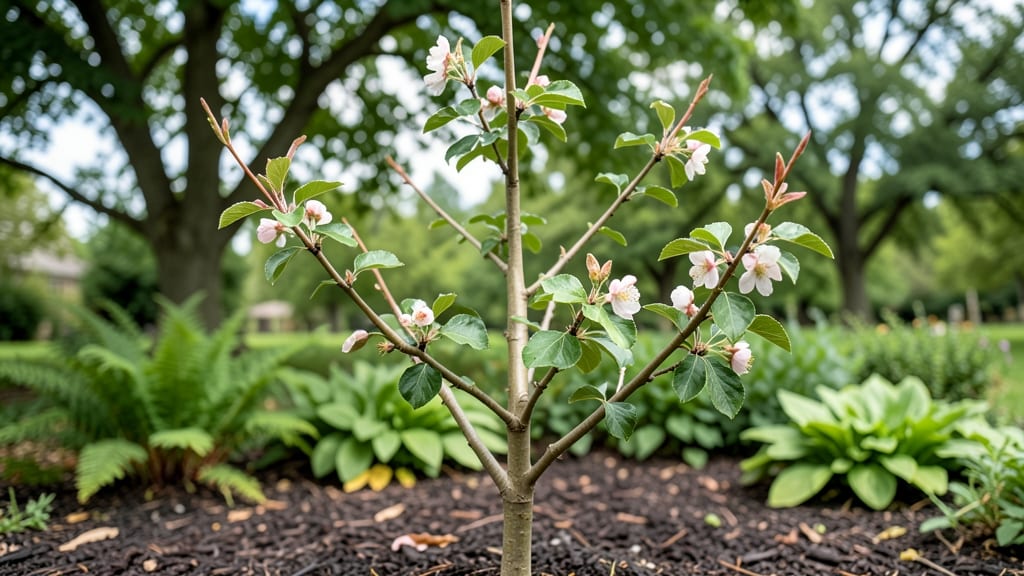
A young apple tree looks like a compact, vibrant plant with glossy, oval-shaped leaves that have jagged edges and a rich green color. Its bark appears smooth and grayish-brown, while its growth habit is bushy and upright, featuring several slender branches. Early spring brings clusters of delicate flowers before the leaves fully emerge.
A young apple tree's most distinctive feature is its leaves, which are typically 1-3 inches long with finely toothed edges that catch light beautifully. 🌿 The bark starts smooth but develops subtle ridges as the tree matures, helping distinguish it from other young fruit trees.
What sets it apart visually are those early spring flowers—white or pink clusters that appear before the leaves, creating a stunning contrast against the bare branches.
When comparing to mature trees, you'll notice the young sapling's branches grow more horizontally at first, creating that classic bushy shape. These branches will later develop into the sturdy scaffold that supports the tree's fruit load.
The growth rate varies by variety, but most young apple trees gain 1-2 feet per year during their first few years, making them relatively quick to identify in a garden setting.
💡 In This Article
- Identifying Young Apple Tree Leaves and Bark
- Growth Stages of a Young Apple Tree
Identifying young apple tree leaves and bark
The leaves of a young apple tree are its most telling feature, with a distinct oval shape measuring 1-3 inches long and 1/2-1 1/2 inches wide. These leaves have serrated edges that create a sawtooth pattern, which helps differentiate them from similar-looking cherry or plum leaves.
The upper surface shines with a deep green hue due to a waxy cuticle that reduces water loss, while the underside appears slightly paler with fine, hair-like structures called trichomes that deter pests.
The bark starts as a smooth, grayish-brown surface when the tree is young, often with subtle horizontal lenticels (tiny raised pores) that allow gas exchange. As the tree ages, these lenticels become more pronounced, and the bark develops shallow ridges that run parallel to the ground.
This texture contrasts sharply with the rougher, more deeply furrowed bark of mature apple trees, which can develop plate-like sections as it thickens over decades. 🌿 The young bark's smoothness also helps distinguish apple saplings from other fruit trees like peach or pear, whose bark often has a more textured appearance even when young.
What makes these leaves particularly distinctive is their vein structure. Each leaf features a central midrib with 5-7 pairs of secondary veins that branch out at angles of about 45 degrees, creating a network that's easily visible when held up to light.
This pattern differs from maple leaves, which have more pronounced veins that create a starburst effect. The leaf's glossy surface also helps it reflect sunlight efficiently, reducing heat stress during summer months when photosynthesis is most active.
Another key identifier is the leaf arrangement—apple trees exhibit alternate leaf placement, meaning each leaf grows from a single point on the stem rather than in pairs. This differs from trees like hawthorn, which have compound leaves with multiple leaflets.
The combination of serrated edges, alternate arrangement, and glossy texture creates a signature look that's hard to confuse with other common fruit tree saplings. 🍏 When examining a young tree, these visual clues work together to confirm its identity before any fruit appears.
Seasonal changes also affect leaf appearance. In spring, new leaves emerge with a reddish tint that fades to green as chlorophyll develops. This temporary coloration helps young trees attract pollinators to their flowers while protecting the leaves from excessive sunlight.
By summer, the leaves reach full size and maintain their glossy finish until autumn, when they develop yellow or orange hues before dropping—a process triggered by shorter daylight hours and cooler temperatures.