
Plants
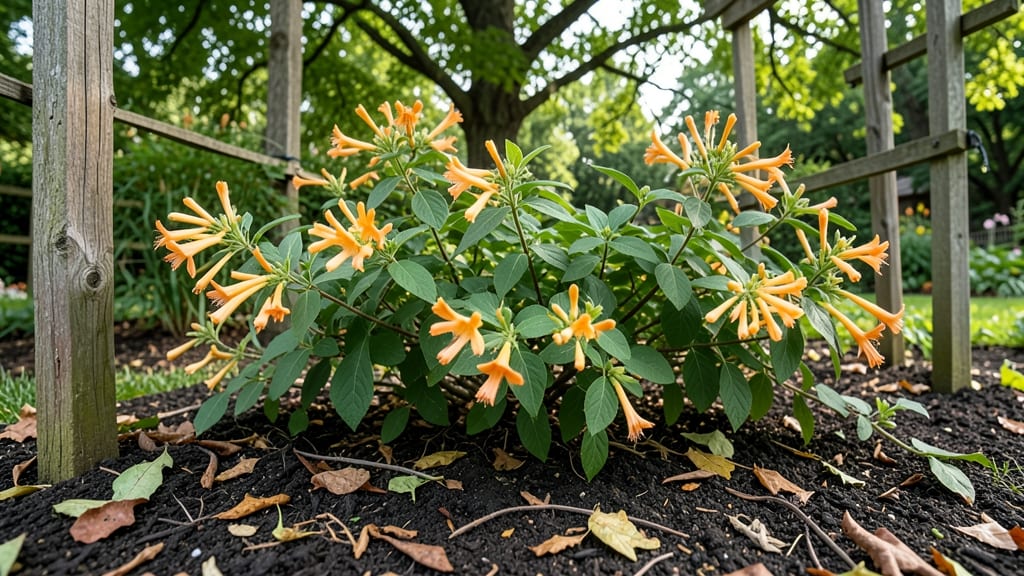
A honeysuckle tree looks like a lush, climbing vine or small tree with glossy, oval leaves that have serrated edges. It produces fragrant tubular flowers in white, yellow, or pink clusters, and its smooth gray bark oozes bitter sap when broken. Most varieties grow 15-25 feet tall with an arching, sprawling form.
A honeysuckle tree's most striking features are its leaves and flowers.
The leaves are dark green and leathery, growing in pairs along the stems, while the flowers—often highly aromatic—appear in late spring to summer. 🌸 Japanese honeysuckle, for example, has creamy-white blossoms, while trumpet honeysuckle showcases vibrant pink or red clusters.
The tree's growth habit is equally distinctive, with some species clinging to trellises or fences like vines, while others develop into multi-stemmed shrubs.
One key identifier is the bitter sap that seeps from the twigs when snapped—a trait shared by many in the Caprifoliaceae family. This sap acts as a natural defense against pests and browsers.
The tree's arching branches create a canopy of foliage that's perfect for shade gardens, but its invasive tendencies mean it can quickly overtake landscapes if left unchecked.
💡 In This Article
- Identifying Honeysuckle Tree Leaves, Flowers, and Bark
- Honeysuckle Tree Growth Habits and Cultivation Tips
Identifying honeysuckle tree leaves, flowers, and bark
The leaves of a honeysuckle tree are one of its most distinctive features, with a dark green, glossy finish that reflects light like polished jade. Each leaf is oval-shaped, measuring about 2-6 inches long and 1-3 inches wide, with finely serrated edges that create a delicate, almost jagged outline.
The leaf arrangement is opposite, meaning two leaves grow directly across from each other at each node along the stem, a key trait for identification. 🌿 Japanese honeysuckle (Lonicera japonica) leaves, for example, have a slightly broader shape, while trumpet honeysuckle (Lonicera sempervirens) leaves are narrower and more elongated.
The tubular flowers are the star attraction, often appearing in clusters of 2-6 blooms along the current year's growth. These fragrant flowers can range from pure white to pale yellow or soft pink, depending on the species, and they emit a sweet, intoxicating scent that's strongest in the evening.
Trumpet honeysuckle flowers, in particular, have a reddish-orange throat that contrasts beautifully with their yellow petals, while Japanese honeysuckle flowers are more uniform in color. The flowers typically bloom from late spring to early summer, with some varieties producing a second flush in fall.
The bark and twigs offer another layer of identification clues. The mature bark is smooth and grayish-brown, often developing a slightly scaly texture as the tree ages. When you break a twig, you'll notice a bitter, milky sap that oozes out—a natural defense mechanism that deters herbivores.
This sap is a dead giveaway when distinguishing honeysuckle from similar-looking vines like wisteria or clematis, which don't produce this characteristic sap. The twigs themselves are slender and slightly zigzag in growth pattern, adding to the tree's unique silhouette.
Seasonal changes also play a role in identification. In fall, the leaves of some honeysuckle varieties turn a soft yellow or bronze before dropping, while others remain evergreen. The flowers may persist on the plant for weeks, especially in cooler weather, creating a long-lasting display.
One common point of confusion is distinguishing honeysuckle from poison ivy, but honeysuckle's glossy leaves and lack of the classic "three-leaflet" arrangement make it easier to spot. The presence of fragrant flowers is another telltale sign—poison ivy has no floral scent.
For a hands-on approach, try this simple test: Rub a leaf between your fingers. Honeysuckle leaves have a slightly waxy texture that feels almost silky to the touch, while their serrated edges create a subtle crinkling sound when crushed.
This tactile feedback, combined with the visual clues, makes identification straightforward once you know what to look for. 🌸 The combination of these features—leaves, flowers, bark, and twigs—creates a distinctive profile that's hard to mistake once you've seen it in person.
If you're still unsure, compare your specimen to a known honeysuckle plant. Notice how the leaves grow in pairs, the flowers cluster along the stems, and the twigs exude sap when broken. These three traits alone can help you confirm whether you're looking at a honeysuckle tree or something else.
The more you observe, the easier it becomes to recognize this versatile and fragrant plant in your landscape.