
Plants
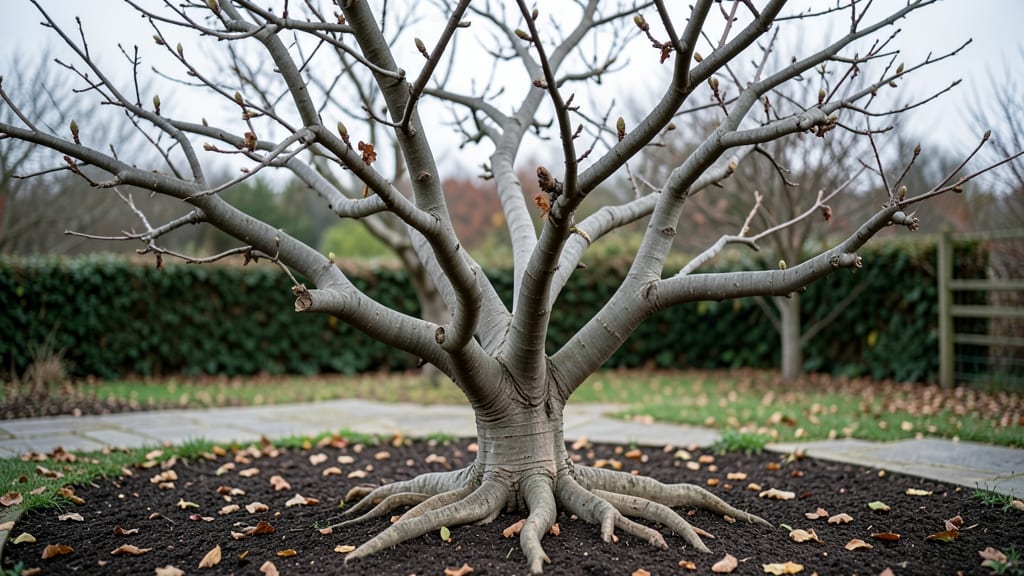
A fig tree in winter looks like a bare-branched skeleton with smooth, grayish-brown bark, occasional dormant buds, and some varieties holding onto a few small leaves. The branches often appear twisted and gnarled, showcasing knobby growth nodes along the trunk.
A fig tree's winter appearance is all about survival mode. 🌳 When temperatures drop, most varieties—especially deciduous types like the Common Smyrna—shed nearly all their leaves to conserve energy, leaving behind stark, leafless branches.
The smooth bark turns a muted gray-brown, while dormant buds along the branches hint at spring's renewal. Some evergreen figs, like the Brown Turkey, might cling to a few small leaves, but their overall structure remains similar: twisted branches with those distinctive knobby growth nodes.
What's fascinating is how these visual cues reveal the tree's health. Healthy fig trees in winter will have firm, unbroken bark without cracks or peeling, while weak branches might show signs of dieback.
The dormant buds, often hidden in the crevices of the bark, are your first clue that life isn't over—they'll swell and burst open when warmer weather arrives.
💡 In This Article
- Fig Tree Winter Dormancy Explained
- Identifying Fig Tree Species by Winter Bark and Branches
Fig tree winter dormancy explained
Fig trees enter winter dormancy as a survival strategy, much like their fruit-bearing cousins in the mulberry family. When temperatures drop below 40°F (4°C), deciduous varieties like the Common Smyrna trigger a hormonal response that causes leaf abscission—the controlled shedding of leaves.
This process involves the formation of an abscission layer at the leaf stem, where specialized cells break down the connection between the leaf and branch. The tree recycles nutrients from the leaves back into its roots and trunk, effectively storing them as starches for spring regrowth.
The bark's transformation is equally revealing. Healthy fig tree bark in winter develops a smooth, almost velvety texture with a muted gray-brown hue, often resembling elephant skin. This bark is actually a protective layer that thickens during dormancy to shield the tree from freezing winds and temperature fluctuations.
Some older trees may show faint vertical ridges or lenticels—tiny pores that allow gas exchange—along the branches. These features distinguish figs from other winter-bare trees like maples, which typically have rougher, more textured bark.
Cold temperatures below 32°F (0°C) also trigger the formation of dormant buds along the branches. These buds, often hidden in the crevices of the bark, contain meristematic cells that will eventually grow into new leaves or fruit clusters when spring arrives.
What's unique about figs is how these buds appear as small, raised bumps or "eyes" along the branches—sometimes clustered in groups of 2-5. This clustering is a key identifier when comparing figs to other fruit trees like apples or pears, which have more evenly spaced buds.
Not all figs follow this exact pattern. Evergreen varieties like the Brown Turkey or Desert King retain some small, leathery leaves year-round, though they'll still shed most foliage during harsh winters.
These varieties often show a mix of old and new leaves, with the remaining leaves appearing darker green and thicker than summer growth. The trade-off is that evergreen figs require more consistent moisture and protection from frost, as their leaves can't photosynthesize efficiently in cold conditions.
Here's what to watch for in your own fig tree: healthy dormant buds should feel firm to the touch, while weak or mushy buds may indicate disease or winter damage.
The bark should remain intact without cracks or signs of peeling—this is a red flag for environmental stress or pest activity.
In regions with hard freezes below 20°F (-7°C), even cold-hardy figs may show some dieback, but the tree's ability to regrow from the roots is what makes them resilient.
What most gardeners don't realize is how the tree's root system plays a crucial role in winter survival. While the above-ground portions appear dormant, the roots continue slow metabolic activity, absorbing moisture and storing nutrients.
This underground activity is why fig trees often bounce back quickly from winter damage—sometimes even producing fruit the following season if conditions are favorable. 🌱