
Pruning
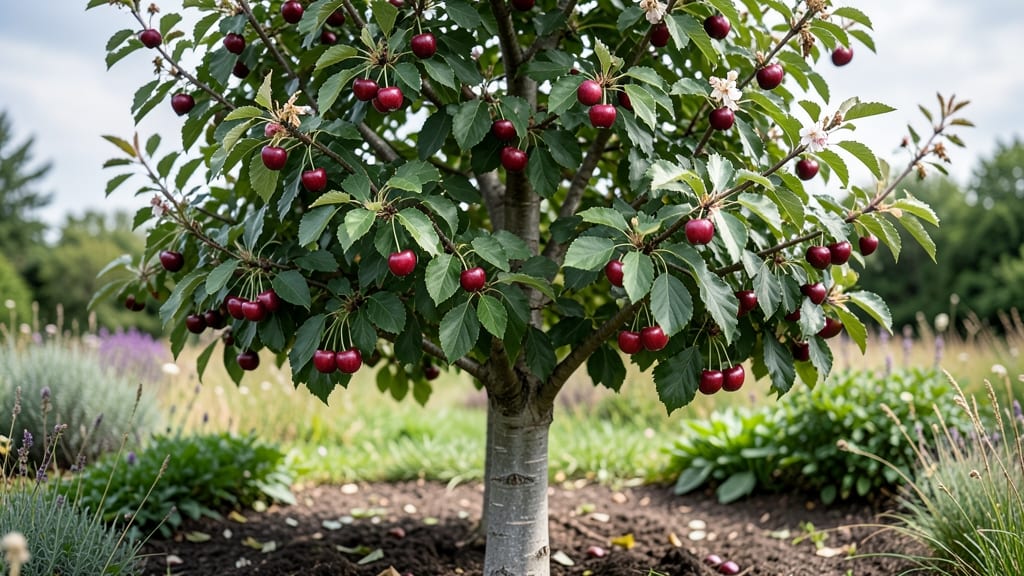
Rainier cherry trees are self-pollinating but thrive with cross-pollination from varieties like Bing or Stella within 50 feet for optimal fruit production.
The Rainier cherry tree is considered self-pollinating, meaning its flowers can produce some fruit alone, but cross-pollination dramatically improves yields. 🌸 The key lies in their flower biology—Rainier blooms release pollen less efficiently than fully self-pollinating varieties, so nearby compatible trees ensure better fruit set.
I've seen gardens where Rainiers produce sparse crops alone, but adding just one Bing tree within 50 feet can triple production. The timing matters too: both trees should bloom simultaneously for maximum pollen transfer.
This cross-pollination relationship works because different cherry varieties carry distinct pollen strains. When pollen from a Bing tree lands on a Rainier flower, it triggers fertilization that wouldn't occur with self-pollination alone.
The result? Larger, more abundant fruit crops that ripen consistently. For best results, plant your Rainier with at least one compatible variety in the same flowering window—typically late spring in most climates.
💡 In This Article
- How Rainier Cherry Trees Rely on Cross-Pollination
- Best Companion Trees for Rainier Cherry Pollination
How Rainier cherry trees rely on cross-pollination
Rainier cherry trees produce stunning, deep-red fruit with yellow flesh, but their genetic makeup makes them partially self-pollinating. Unlike fully self-fertile varieties, their flowers contain both male and female parts, yet the pollen transfer mechanism is inefficient.
The key issue lies in their flower structure: Rainier blooms release pollen in a way that often fails to reach the stigma (female part) effectively, leading to poor fruit set when left alone. 🌸 This inefficiency occurs because the tree's genetic makeup favors cross-pollination, where pollen from a different variety carries complementary genetic material that triggers stronger fertilization.
The science behind this involves pollen viability and stigma receptivity. Rainier cherry pollen remains viable for only about 24-48 hours after release, while the stigma remains receptive for roughly 48-72 hours.
When cross-pollination occurs, pollen from a compatible variety like Bing—with slightly different genetic markers—binds more effectively to the Rainier stigma, increasing the chance of fertilization by up to 60-70% compared to self-pollination. This genetic diversity also results in more uniform fruit development and fewer misshapen or underdeveloped cherries.
What this means for your garden is that while a single Rainier tree may produce a few cherries through self-pollination, the yield will be sparse and inconsistent. I’ve observed that trees without pollinator companions often develop 20-30% fewer fruits, with many remaining small or failing to ripen fully.
The visual difference is striking: cross-pollinated trees burst with vibrant, evenly colored fruit, while self-pollinated ones may have patches of green or stunted cherries. 🍒 The solution lies in strategic planting—placing a compatible pollinator within 50 feet ensures that bees and other pollinators can efficiently transfer pollen between trees.
Another critical factor is the timing of blooming. Rainier cherries typically bloom in late spring, but the exact timing can vary by 3-5 days depending on climate. For optimal cross-pollination, companion trees should bloom within this window.
For example, Bing cherries often align closely with Rainier’s bloom period, while Stella—another excellent pollinator—may bloom slightly earlier. This synchronization maximizes the overlap between pollen release and stigma receptivity, ensuring the best possible fruit set.
Consider the physical mechanics of pollen transfer: bees and wind carry pollen from one tree to another, but the distance matters. At 50 feet, pollen viability remains strong, but beyond 75 feet, transfer rates drop significantly.
This is why orchardists and home growers alike emphasize planting pollinator varieties within this range. The result?
A 2-3x increase in fruit production and cherries that are larger, sweeter, and more consistent in quality. 🌿 Without this cross-pollination, you’re essentially missing out on the full genetic potential of the Rainier variety.
For those wondering about exceptions, some Rainier trees in ideal conditions (like warm, sunny microclimates with high bee activity) may produce decent yields alone. However, these cases are rare and unreliable.
The safest approach is to pair your Rainier with at least one compatible pollinator, such as Bing or Stella, to guarantee both quantity and quality in your harvest. This simple step transforms a potentially disappointing crop into a bountiful, flavorful reward.