
How To
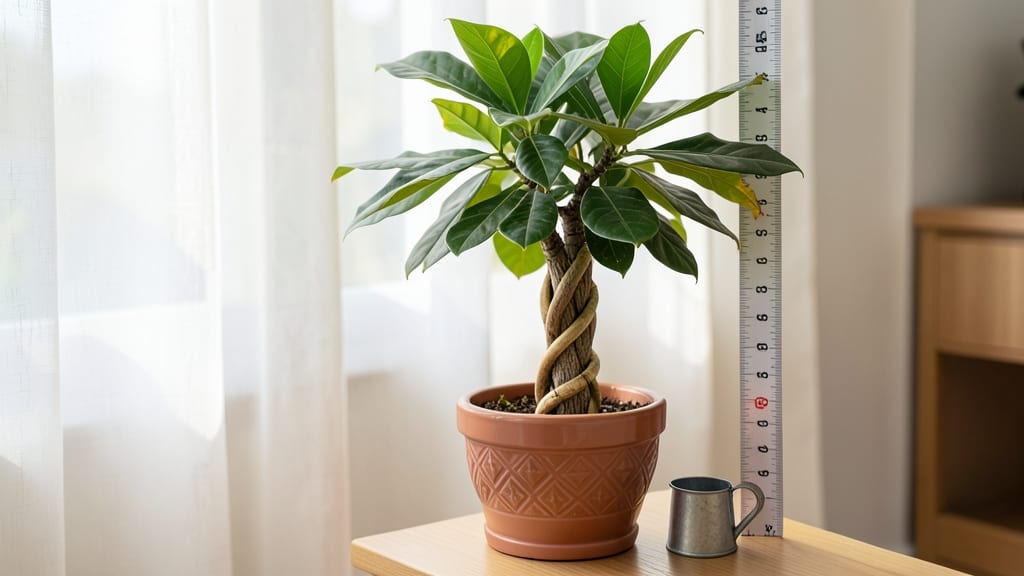
A money tree 💰 can grow between 6 and 10 feet tall indoors with the right care—but that’s not always the case. If you’ve ever wondered whether your Pachira aquatica will soon reach the ceiling, the answer depends on its variety, your growing conditions, and how you prune it.
Most money trees grow at a steady 1 to 2 feet per year when happy, but some varieties stay compact while others shoot up quickly. Without pruning, a standard money tree could outgrow its space faster than you expect, especially in bright, warm conditions.
Light, pot size, and humidity all play a role in how tall your money tree becomes. Too much direct sun or a cramped pot can send it on a growth spurt, while neglecting fertilizer or water can stunt its progress entirely.
In this guide, I’ll break down the height ranges by variety, how to control growth with pruning, and the key care tips to keep your money tree thriving—whether you want a small tabletop plant or a towering indoor statement piece.


Money tree height limits by variety: small vs. large-growing types
Your money tree (Pachira aquatica) might seem like a slow grower, but its mature height varies dramatically by variety. Some stay compact at 3 feet tall, while others can reach 10 feet indoors with proper care.
Understanding these differences helps you choose the right type for your space and manage its growth effectively.
Most money trees fall into three main height categories: dwarf varieties (under 5 feet), standard types (5–8 feet), and large-growing cultivars (8+ feet). The variety you pick isn’t just about aesthetics—it determines how often you’ll need to prune or repot to keep your plant happy and contained.
Here’s how the most popular varieties compare in terms of mature height and growth habits:
The standard Money Tree (Pachira 'Money Tree') is the most common variety, often reaching 10 feet indoors if left unchecked.
Its rapid growth rate of 1–2 feet per year means you’ll need to prune it annually to keep it at a manageable height, like 5–6 feet, for most living spaces.
If you prefer a low-maintenance option, the Raffia Palm variety grows slowly—only 6–12 inches per year—and tops out at 5 feet. This makes it perfect for small apartments or offices where space is limited. Its minimal pruning needs also save you time and effort.
For those who love bold foliage, the Golden Shower variety is stunning but fast-growing, reaching 12 feet indoors without intervention. Its vibrant yellow-green leaves make it a showstopper, but its height requires frequent pruning or a large, open space like a conservatory.
Pruning isn’t just about controlling height—it also encourages bushier growth. When you cut back 1/3 of the plant’s height in spring, you’ll see multiple branches form, creating a fuller, more balanced shape. This is especially useful for braided Money Trees, where pruning helps maintain the intricate braided stems.
Pot size plays a huge role in how tall your money tree grows. If you want to limit height, choose a smaller pot (10–12 inches in diameter) to restrict root growth.
Conversely, a large pot (16+ inches) encourages faster, taller growth. Always use a pot with drainage holes to prevent root rot, which can stunt growth.
Light exposure affects height too. While money trees thrive in bright indirect light, they’ll grow taller and leggier if deprived of sufficient light. Place your plant near an east- or west-facing window for ideal conditions. Avoid south-facing windows, where direct sun can scorch the leaves and slow growth.
With the right variety and care, you can keep your money tree at your desired height—whether that’s a compact 3-foot tabletop plant or a tall, statement-making 10-foot indoor tree.
Start by choosing a variety that fits your space, then adjust pruning and pot size as needed to maintain its ideal height.
How fast does a money tree grow indoors? Factors affecting height
Your money tree (Pachira aquatica) typically grows about 1–2 feet per year indoors, but this can vary based on care. With ideal conditions—like bright indirect light and proper humidity—some varieties even reach 3 feet annually. Understanding these growth factors helps you manage your plant’s height and keep it thriving.
Growth speed depends on three key elements: light exposure, pot size, and humidity levels. A money tree in a cramped pot or low-light spot will grow slower, while one with ample space and sunlight can shoot up faster.
Pruning also plays a role—regular trimming encourages bushier growth and controls height.
- 1–2 feet/year is the average growth rate for indoor money trees.
- Bright indirect light speeds up growth by 20–30% compared to low-light conditions.
- Pot size matters: Upgrade pots every 1–2 years to accommodate root growth.
- Humidity above 40% prevents leaf drop and supports faster, healthier growth.
- Prune in spring to control height and encourage bushier foliage.
If your money tree isn’t growing as expected, check its light source. Place it near an east or west-facing window for optimal 4–6 hours of filtered sunlight daily. Avoid south-facing windows, which can scorch leaves. A simple fix like rotating the pot weekly ensures even growth.
Pot size directly impacts height—roots need room to expand. Start with a 6–8 inch pot and upgrade to 10–12 inches once roots fill the current container. Overcrowded roots slow growth, while ample space encourages upward and outward expansion. Always use pots with drainage holes to prevent root rot.
Humidity is another game-changer. Money trees thrive in 40–60% humidity, but indoor air is often drier. Use a pebble tray or humidifier near your plant to mimic tropical conditions. Low humidity causes brown leaf tips, which stunts growth. Mist leaves lightly 2–3 times weekly for extra moisture.
To control height, prune your money tree in early spring before new growth starts. Cut back leggy stems by 1/3 to encourage branching. Use clean, sharp scissors and seal cuts with cinnamon powder to prevent disease.
Pruning not only shapes your plant but also boosts bushiness, making it fuller and more compact.