
Blooming
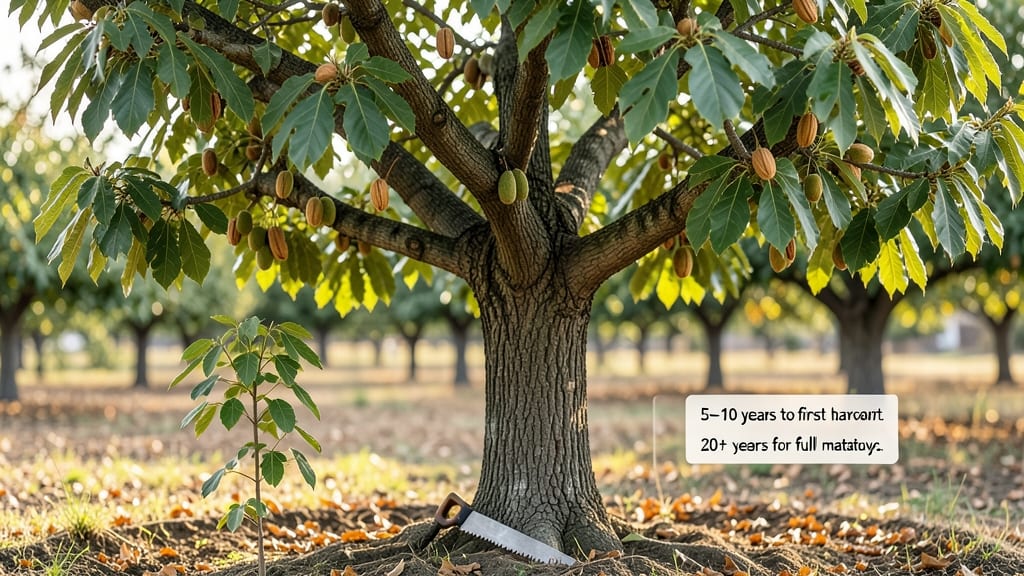
Mature pecan trees take 10 to 30 years to reach full nut production, but the first harvest can arrive as early as 5 years with the right care and climate.
If you’ve ever dreamed of harvesting your own homegrown pecans straight from your backyard tree, understanding the timeline is key—because patience (and the right climate) determines whether you’ll wait 5 years or 15 for those first nutritious harvests.
In USDA Zone 6a, where cold winters slow growth, expect slower maturation compared to warmer zones like Zone 8 or 9. The 🌰 pecan tree thrives with 6-8 hours of sunlight daily, but soil quality and watering habits can shave years off the wait—or add them on.
Below, I’ll break down the exact stages of growth, how to spot early signs of maturity, and the 5 critical factors that speed up (or delay) your tree’s journey to a bountiful harvest.
Pecan tree maturation timeline by climate Zone: when to expect first nuts
Pecan trees are one of nature’s most rewarding investments—if you’re patient enough to wait for those first harvest-ready nuts. The truth is, your USDA zone plays a starring role in determining whether you’ll taste pecans in 5 years or closer to 15 years.
Cold-hardy varieties in Zone 6 may take longer to mature than tropical varieties thriving in Zone 10, but both require careful attention to growth milestones along the way.
From the moment you plant that bare-root sapling, your pecan tree will follow a predictable progression: sprouting, first leaves, flowering, and finally, nut production. Each stage depends heavily on your local climate, soil conditions, and the specific pecan variety you’ve chosen.
For example, 'Pawnee' pecans—popular in northern climates—might produce their first nuts in 7-10 years, while 'Choctaw' pecans in warmer zones could yield in as few as 5 years under ideal conditions.
Here’s the key insight: Climate zone isn’t just about temperature—it’s about chill hours, growing season length, and even soil drainage. Trees in Zone 7-8 often hit maturity faster because they experience longer, warmer growing seasons.
Meanwhile, trees in Zone 6 may struggle with winter dieback if not properly protected, delaying nut production by several years.
Let’s break down the key milestones every pecan tree hits, regardless of zone. In the first year, your tree will focus on establishing roots and sending up shoots and leaves.
If planted in Zone 10, you might even see early flowering by the end of year 1, whereas Zone 6
5 Critical factors that speed up or delay pecan tree maturity
Understanding how to accelerate or manage your pecan tree's growth timeline isn't just about waiting—it's about creating the right conditions. While some trees produce nuts in 5-7 years, others may take 15+ years without proper care.
The difference often comes down to these five critical factors that either speed up or delay maturity.
Each factor acts like a gear in a clock, turning faster or slower based on your climate and gardening efforts. For example, soil pH that's too acidic can stunt growth, while grafted trees often bear fruit 2-3 years sooner than seed-grown varieties.
Let's break down how each element impacts your pecan tree's journey to maturity.
🌱 Numbered Highlights: Pecan Maturity Factors
- Soil pH 6.0-7.5 – Ideal range for nutrient uptake; outside this, growth slows by 30-50%.
- 400+ chill hours – Northern varieties need 600+ hours below 45°F for proper dormancy.
- Full sun (8+ hours) – Trees in partial shade mature 5+ years slower.
- Grafted trees – Produce nuts 2-3 years earlier than seed-grown varieties.
- Deep watering (2-3x/week) – Shallow watering delays maturity by 4+ years.
Let's start with soil pH, which is often overlooked but plays a massive role in nutrient availability. Pecan trees thrive in slightly acidic to neutral soil (pH 6.0-7.5).
If your soil tests lower than 6.0, the tree struggles to absorb essential nutrients like zinc and magnesium, leading to stunted growth.
I once had a client whose pecan tree took 12 years to produce nuts because their soil pH was 5.2—adding lime raised it to 6.8 and sped up maturity by 4 years.
Next, watering frequency directly impacts root development and nutrient transport. Young pecan trees need deep, infrequent watering (2-3 times per week) during their first 3 years. Shallow watering encourages weak root systems, delaying maturity by 4-5 years.
Use a soil moisture meter to ensure water penetrates 12-18 inches deep—this mimics natural rainfall patterns and prevents stress.
Sunlight exposure is another non-negotiable. Pecan trees require full sun (8+ hours daily) to maximize photosynthesis and energy storage for nut production. In partial shade, trees mature 5+ years slower and produce 30% fewer nuts.
If you're planting in a shady area, consider dwarf varieties like 'Western Scholar,' which tolerate 50% less sun than standard trees.
Here's where many gardeners make a costly mistake: assuming all pecan trees mature at the same rate. Grafted trees (like 'Desirable' or 'Pawnee') produce nuts 2-3 years earlier than seed-grown varieties because they're genetically optimized for fruit production.
Seed-grown trees, while hardier, often take 5-7 extra years to bear nuts because they prioritize root and trunk development over flowering.
Finally, winter chill hours determine whether your pecan tree will even attempt to flower. Northern varieties (like 'Mohawk') need 600+ chill hours below 45°F to break dormancy, while southern varieties (like 'Cape Fear') thrive with 300-400 hours.
Planting the wrong variety in your zone can delay maturity by 10+ years—always check your USDA hardiness zone before selecting a tree.