
Companion Plants
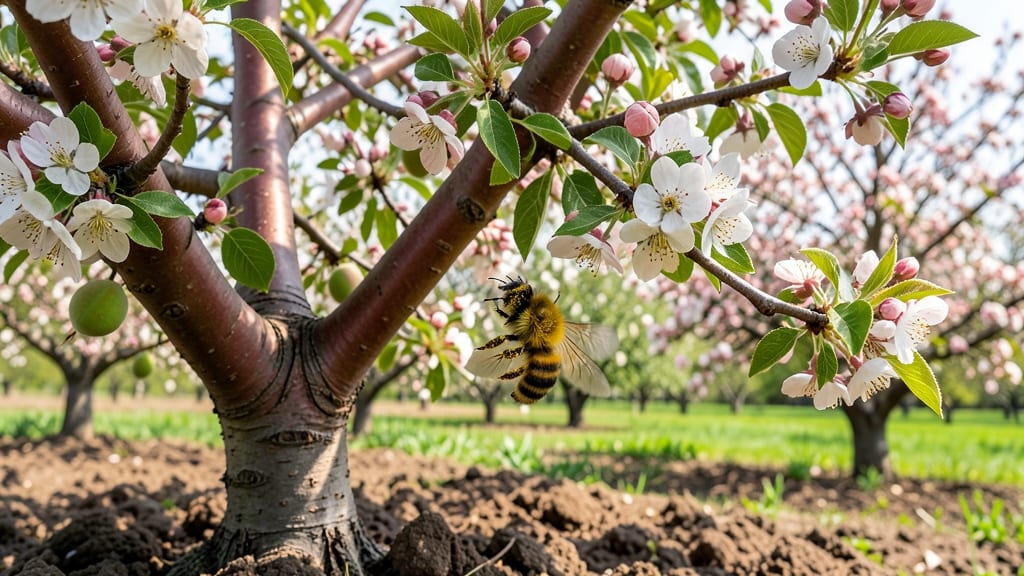
Peach trees cannot pollinate apple trees because they belong to different botanical families—Prunus for peaches and Rosaceae for apples—meaning their flowers are incompatible for cross-pollination, even if planted nearby.
Peach and apple trees belong to entirely different plant families, which means their flowers aren't designed to work together. 🌸 The pollen from a peach tree simply won't trigger the reproductive process in an apple blossom, and vice versa.
This incompatibility isn't just about proximity—it's a fundamental biological mismatch that affects everything from flower structure to pollen transfer. Even if you plant them side by side, you won't see any hybrid fruit developing because their genetic pathways are completely separate.
What's interesting is how this affects fruit production. While peach trees can often self-pollinate or cross-pollinate with other Prunus varieties, apple trees typically need compatible pollinators from the same Rosaceae family.
This is why commercial orchards carefully select pollination partners—when you're dealing with fruit trees, getting the right genetic match is absolutely critical for a good harvest.
If you're looking to maximize fruit production, focus on planting compatible varieties within each family. For peaches, other stone fruits like plums or nectarines make excellent neighbors, while apples thrive when paired with crabapples or other apple cultivars. The key is understanding these botanical relationships before planning your orchard layout.
💡 In This Article
- Botanical Differences Between Peach and Apple Trees
- Best Pollination Partners for Peach and Apple Trees
Botanical differences between peach and apple trees
The core reason peach and apple trees can't cross-pollinate lies in their genetic families. Peaches belong to the Prunus genus (subfamily Prunoideae), while apples are in the Malus genus (subfamily Maloideae) within the Rosaceae family.
This family-level separation means their reproductive systems evolved independently over millions of years, creating fundamental differences in flower anatomy and pollen compatibility.
Apple blossoms have 5 petals and 20 stamens, producing pollen grains that are 30-40 microns in diameter—optimized for transfer by bees within the same family. Peach flowers, by contrast, have 5 petals but only 20-30 stamens, with pollen grains measuring 25-35 microns and shaped differently.
The pollen's surface proteins act like a biological key that only fits specific locks in compatible flowers, triggering fertilization. When peach pollen lands on an apple stigma, the chemical signals simply don't align to initiate fruit development.
Another critical difference is their pollen tube growth patterns. After pollination, compatible pollen grows tubes through the style (flower's neck) at rates of 1-2 mm per hour to reach the ovary.
Peach pollen tubes grow at 1.5-2.5 mm/hour in compatible hosts, but when placed on apple stigmas, they either fail to germinate or grow erratically. This mismatch explains why you'll never see peach-apple hybrids—even if pollination occurred (which it doesn't), the genetic instructions for combining their DNA don't exist in nature.
Consider the fruit development process as another clue. Apples require fertilization to trigger auxin hormone production in the ovary, which stimulates cell division and fruit swelling. Peach trees, however, can produce fruit through parthenocarpy (seedless development) in some varieties, but this is a separate biological pathway that apples lack entirely.
The two species are like ships passing in the night—biologically incapable of recognizing each other's reproductive signals.
Even if you could force pollination (which you can't), the resulting hybrid would be sterile. The chromosomal differences between Prunus and Malus species create polyploid barriers—typically 16 chromosomes in peaches vs. 34 in apples—making successful meiosis (cell division) impossible in offspring.
This genetic incompatibility is why botanists classify them as entirely separate breeding groups, despite both being fruit trees.
For visual learners, imagine trying to fit a square peg into a round hole. The peach flower's reproductive parts are shaped for other stone fruits, while apple flowers evolved to work with their own kind.
This isn't just about proximity—it's about millions of years of evolutionary divergence that created fundamentally different biological systems for reproduction.