
Trees
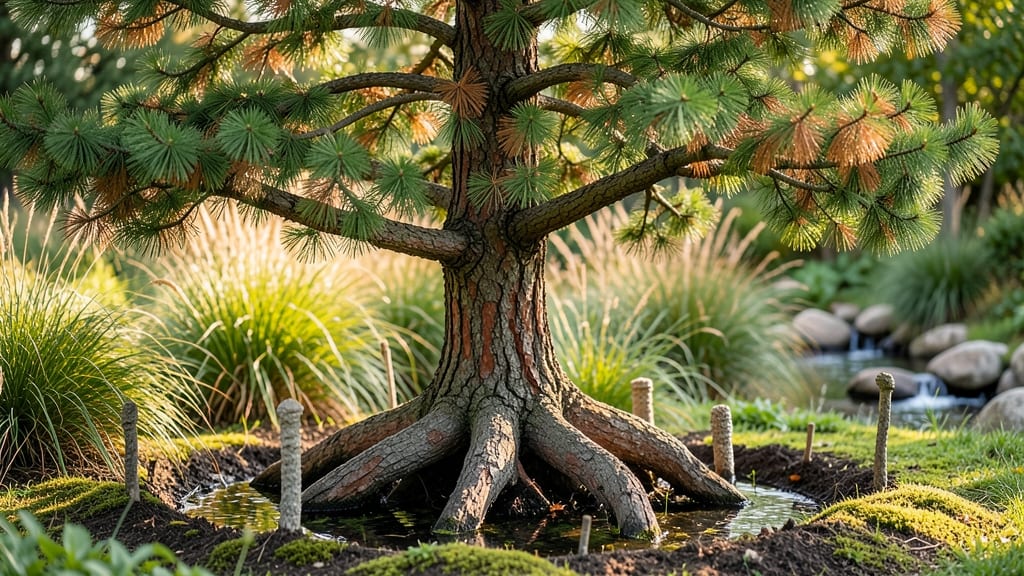
The tree that never has leaves is an evergreen, with conifers like pine, spruce, and fir leading the pack by keeping needle-like foliage year-round for continuous photosynthesis.
Evergreens stay green all year because their needle-shaped leaves are perfectly adapted to cold climates. 🌲 Unlike broad leaves that lose water quickly, these tiny needles have thick, waxy coatings that lock in moisture while still capturing sunlight for photosynthesis.
This adaptation lets them thrive in winter when most trees would struggle to survive. The trade-off? Their needles last 2-7 years before falling, unlike annual leaves that refresh every season.
These trees aren't just hardy—they're also architectural stars in landscaping. Blue spruce and juniper varieties offer striking colors and shapes that maintain their beauty through snow and frost.
For gardeners in colder regions, evergreens provide year-round structure and privacy, making them the ultimate low-maintenance choice for green thumbs and busy homeowners alike.
💡 In This Article
- Why Evergreen Trees Keep Needles Instead of Leaves
- Best Evergreen Trees for Year-Round Landscaping
Why evergreen trees keep needles instead of leaves
Evergreen trees replace traditional leaves with needle-like foliage because this shape drastically reduces water loss in cold, dry conditions. These tiny needles—often just 1-4 centimeters long—have a thick, waxy cuticle that acts like a built-in moisture barrier.
This adaptation prevents the rapid evaporation that would cripple broad leaves during winter's freezing temperatures and low humidity. 🌬️ The needle structure also creates a microclimate that minimizes wind exposure, further conserving precious water reserves.
The secret lies in their internal anatomy too. Evergreen needles contain specialized cells called resin ducts that produce natural antifreeze compounds, allowing photosynthesis to continue even when temperatures drop below 32°F.
Unlike deciduous trees that shed leaves annually to conserve energy, evergreens maintain their foliage year-round, though individual needles typically last 2-7 years before falling and being replaced. This gradual turnover means evergreens never go completely bare, even in harsh winters.
Another key difference is the surface area-to-volume ratio. Needles have a much smaller surface area compared to broad leaves, which reduces water loss while still capturing enough sunlight for photosynthesis.
For comparison, a single broadleaf might have 100 times more surface area than a pine needle, making it far more vulnerable to desiccation. This evolutionary trade-off explains why evergreens dominate cold climates—from the Rocky Mountains to Scandinavian forests—where survival depends on efficient resource management.
What most people don't realize is that evergreen needles also contain higher concentrations of chlorophyll than broad leaves, which helps them absorb more light during the limited winter sunlight. This adaptation, combined with their slow metabolic rate, allows evergreens to photosynthesize at temperatures where deciduous trees would be dormant.
The result? A tree that stays green, productive, and structurally intact through all four seasons. 🌿
Consider the Eastern White Pine as a perfect example. Its flexible, blue-green needles grow in clusters of 5, creating a dense canopy that blocks snow accumulation while still allowing light penetration. This design not only preserves moisture but also prevents branch breakage under heavy winter loads.
The same principles apply to other conifers like fir and spruce, though their needle arrangements vary—fir needles are flat and attached individually, while spruce needles grow singly around the branch.
This botanical marvel isn't just about survival—it's about efficiency. Evergreens have evolved to maximize photosynthesis while minimizing resource expenditure, making them the ultimate cold-weather specialists. Their needle-based strategy represents a perfect balance between form and function in nature's most resilient trees. 🌲