
Plants
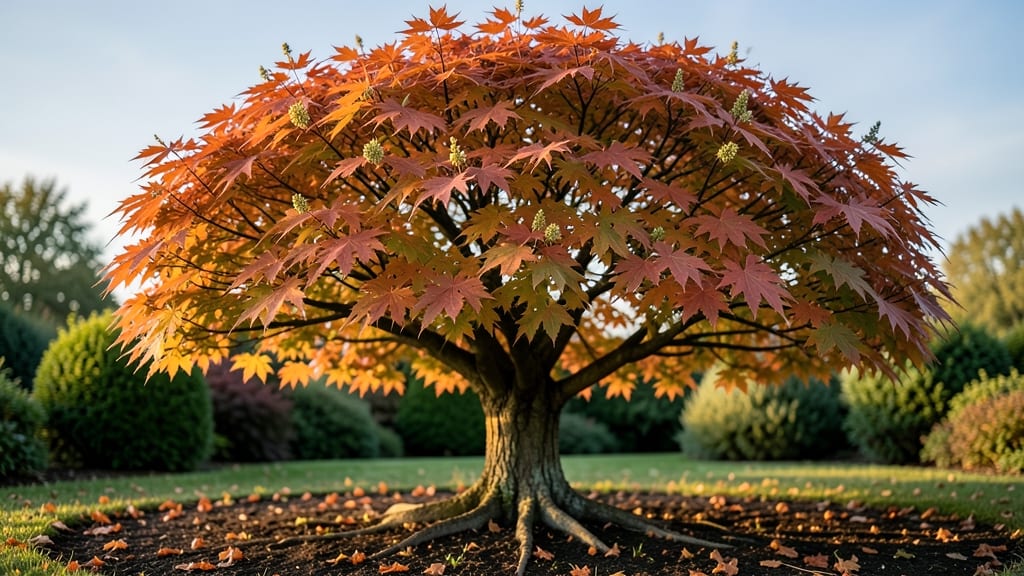
A maple tree looks like a tree with distinctive lobed leaves featuring 3-7 sharp points, smooth gray bark that develops deep grooves as it matures, and brilliant autumn foliage in shades of orange, yellow, or deep red. Most varieties reach heights of 40-70 feet with a broad, rounded shape.
A maple tree's most recognizable feature is its palmate leaves, where all lobes radiate from a single point like fingers on a hand. 🌿 The bark starts smooth and silvery-gray but develops striking vertical ridges as the tree ages, especially in species like the sugar maple.
What many people don't realize is how dramatically these trees change throughout the year—spring brings delicate green buds, summer showcases full leaf canopies, and fall transforms them into fiery red or golden displays that dominate landscapes.
Young maple trees often have thinner, more delicate bark and smaller leaves, while mature specimens develop thicker trunks and wider canopies that can span 30-50 feet across.
The leaf shape alone can help identify different species—sugar maples have more pronounced lobes, while silver maples feature silvery undersides that catch the light beautifully.
💡 In This Article
- Identifying Maple Tree Leaves and Bark Patterns
- Seasonal Appearance Changes in Maple Trees
Identifying maple tree leaves and bark patterns
The palmate leaf structure of maple trees is their most defining feature, where 3-7 sharp, pointed lobes radiate outward from a single central point like fingers on a hand. 🌿 This unique shape creates a "hand-like" silhouette when viewed from above.
The leaf edges typically have serrated teeth, and the veins form a distinctive web pattern that strengthens the leaf's structure. Sugar maples, for example, have 5 lobes with deep notches between them, while red maples often display 3-5 lobes with shallower indentations.
Bark texture transforms dramatically as maple trees mature. Young specimens sport smooth, silvery-gray bark that resembles elephant skin, but by 20-30 years old, the bark develops deep, vertical ridges that create a rugged, almost sculptural appearance.
Sugar maples develop particularly striking dark gray bark with pronounced furrows, while silver maples maintain a lighter, more scaly texture. The bark's color and pattern can actually help identify the species from a distance—something foresters rely on during surveys.
Leaf color provides another key identification clue. Sugar maples turn brilliant red-orange in autumn, while red maples develop fiery scarlet hues. Silver maples, however, produce more muted yellows. 🍂 The undersides of silver maple leaves have a distinctive silvery sheen caused by fine hairs that reflect light differently.
This trait gives the species its name and makes it easily distinguishable from other varieties.
What's fascinating is how these characteristics develop through photosynthesis. The lobed leaf shape maximizes surface area for light absorption while the vein structure creates an efficient water transport system. The bark's ridges actually help the tree maintain stability during storms by distributing wind forces more evenly.
This combination of form and function makes maples both beautiful and resilient in woodland ecosystems.
For practical identification, focus on these three features: leaf lobe count and shape, bark texture (smooth vs ridged), and autumn color palette.
A sugar maple will typically show 5 lobes with deep notches, dark gray ridged bark, and vibrant red foliage, while a red maple might have 3-5 lobes, lighter bark, and more orange-red leaves. These differences become especially noticeable when comparing mature specimens side by side.
One common mistake is confusing maple leaves with oak leaves. While both have lobes, maple lobes all connect to a single point, whereas oak leaves have lobes that don't always meet at the center. This subtle difference can be crucial when trying to identify trees in mixed forests. 🌳