
Plants
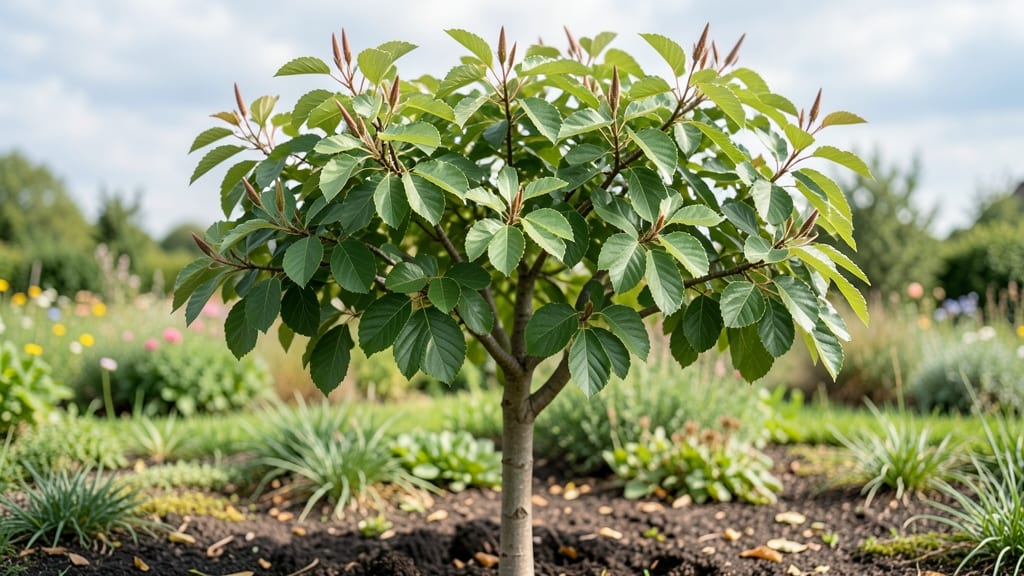
A young walnut tree looks like a delicate sapling with smooth, light gray bark and compound leaves made of 5-9 oval leaflets featuring serrated edges. Its early growth includes a slender trunk that gradually thickens, while the tree's rounded canopy begins to form with lobed leaves similar to hickory trees.
A young walnut tree's most striking feature is its compound leaves, which set it apart from many other trees.
These leaves, with their 5-9 leaflets, create a distinctive fan-like shape that catches sunlight beautifully. 🌿 The bark remains smooth and light gray during early growth, providing a stark contrast to the darker, rougher bark of mature trees.
As the tree develops, its growth habit becomes more noticeable—starting slender but eventually forming a broad, rounded canopy that provides ample shade.
One key identification tip is comparing walnut leaves to similar trees like hickory or butternut. Walnut leaves tend to be slightly more elongated and less deeply lobed than hickory leaves, which helps in early-stage identification.
The combination of these leaf characteristics and the smooth bark makes young walnut trees relatively easy to spot in the right conditions.
💡 In This Article
- Identifying Young Walnut Trees by Leaf and Bark Features
- Early Growth Stages and Care Tips for Walnut Saplings
Identifying young walnut trees by leaf and bark features
The compound leaves of a young walnut tree are its most distinctive identifier. Each leaf consists of 5-9 oval leaflets arranged alternately along a central stem, creating a fan-shaped silhouette that's 4-8 inches long.
The leaflets have serrated edges and a slightly pointed tip, giving them a delicate yet sturdy appearance. These leaflets emerge from a single central stem called the rachis, which helps distinguish walnut leaves from simple leaves or those of similar trees.
The bark of a young walnut tree is another key feature. When the tree is just a sapling, its bark appears smooth and light gray, almost silvery in sunlight. This smooth texture contrasts sharply with the deeply furrowed, dark brown bark of mature walnut trees.
The transition occurs gradually—typically between 5-10 years—as the tree's trunk thickens and develops protective ridges. This smooth bark phase is crucial for identification, as it's often overlooked in favor of focusing solely on leaves.
To differentiate walnut trees from their close relatives like hickory or butternut, examine the leaf structure closely. Walnut leaves tend to have smoother, less deeply lobed leaflets compared to hickory's more jagged, 7-9 leaflets with pronounced serrations.
Butternut leaves, while similar, often have a more elongated shape and a slightly yellowish-green hue when mature. The walnut's leaflets also lack the hairy undersides found on some hickory varieties, making them feel smooth to the touch.
The growth habit of young walnut trees further aids identification. Saplings develop a slender, upright trunk that branches out into a bushy, rounded canopy as they mature. This early branching pattern helps them compete for sunlight in dense woodlands.
Unlike oak trees, which often have a more spreading habit, walnut saplings maintain a compact, symmetrical shape during their first 3-5 years of growth.
One fascinating detail is how walnut leaves change seasonally. In spring, new leaves emerge a vibrant reddish-purple color before turning green—a trait shared with some hickory varieties but more pronounced in walnuts. This color shift is due to anthocyanin pigments that protect young leaves from excessive sunlight.
By summer, the leaves develop their characteristic deep green hue, which helps them efficiently capture sunlight for photosynthesis.
For those in temperate climates, young walnut trees often produce their first small, green flower clusters (catkins) in early spring, though these aren't always visible on saplings. The male flowers appear as hanging, yellowish strands, while female flowers are reddish and more compact.
These reproductive structures appear before the leaves fully unfurl, adding another layer of identification during the March-April growing season.