
Blooming
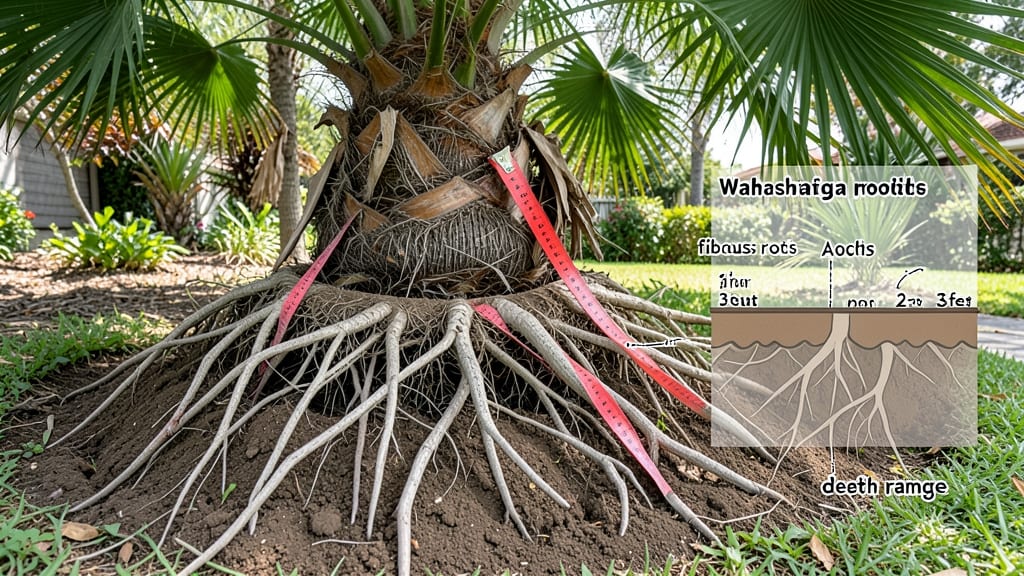
Palm tree roots spread 2 to 3 times the tree’s height outward and penetrate 6 to 12 inches deep, though varieties like the coconut palm can extend much deeper and wider. Their growth patterns depend heavily on the species, age, and soil composition.
Understanding palm tree root systems helps explain why some species thrive in sandy soils while others struggle in clay. 🌳 The lateral spread is what often causes surprise damage—imagine a 30-foot-tall palm stretching roots 60 to 90 feet outward!
This aggressive horizontal growth is why landscapers recommend planting palms at least 15 feet from structures. What's fascinating is how root depth adapts: while most palms stay shallow, the coconut palm can send roots down 3 feet or more to access groundwater, making it uniquely resilient in coastal areas.
For homeowners, this means proper spacing and soil preparation are critical. Windmill palms, for example, develop shallow but wide-spreading roots that can crack sidewalks, while date palms grow deeper but more localized systems. Testing soil drainage before planting can prevent costly root-related problems down the line.
💡 In This Article
- Palm Tree Root Systems by Species: Depth and Spread Variations
- How to Protect Structures and Landscaping from Palm Tree Roots
Palm tree root systems by species: depth and spread variations
Palm tree roots exhibit fascinating diversity across species, shaped by evolutionary adaptations to their native environments. The coconut palm (Cocos nucifera), for instance, develops a unique "taproot" system that can extend 3 to 5 feet deep to access groundwater in coastal regions.
This vertical growth contrasts sharply with the windmill palm (Trachycarpus fortunei), which spreads shallow but aggressive roots just 6 inches below the surface—perfect for stabilizing sandy soils but notorious for cracking pavement. 🌴
Most palms follow the 2:1 ratio rule: horizontal spread equals 2-3 times the tree's height, while depth rarely exceeds 12 inches.
The date palm (Phoenix dactylifera), however, breaks this pattern with a deep, fibrous root system that can reach 15 feet down in arid climates, allowing it to survive prolonged droughts.
Meanwhile, royal palms (Roystonea spp.) grow dense, shallow lateral roots that spread 50-70 feet wide—explaining why they're often planted as windbreaks in hurricane-prone areas.
Soil type dramatically alters root behavior. In sandy soils, palms like the canary island palm (Phoenix canariensis) develop extensive lateral roots to anchor themselves, while in clay-heavy soils, species like the pygmy date palm (Phoenix roebelenii) grow deeper to escape compaction.
The Mexican fan palm (Washingtonia robusta) demonstrates this adaptation perfectly: its roots spread 30-50 feet wide but only penetrate 8-12 inches deep in well-drained soils, while in waterlogged areas, they'll grow downward to 2 feet for oxygen.
Age plays a critical role too. Young palms focus energy on vertical growth, while mature trees prioritize lateral expansion. A 10-year-old coconut palm might have roots spreading 20 feet wide but only 18 inches deep, while a 50-year-old specimen could stretch roots 60 feet outward with 3-foot-deep anchors.
This progression explains why newly planted palms seem harmless—until they mature and reveal their full root potential. 🌱
Climate influences root development too. Humid tropical palms like the sabal palm (Sabal palmetto) grow dense, shallow root mats to maximize water absorption during frequent rains, while desert-adapted palms like the palmilla (Brahea spp.) develop deep, sparse roots to conserve moisture.
Even within species, individual trees adapt: a coconut palm in loamy soil might grow roots 20% deeper than one in pure sand, demonstrating nature's remarkable flexibility.
Understanding these patterns helps explain why some palms thrive in urban landscapes while others become nuisances.
The Mediterranean fan palm (Chamaerops humilis), for example, stays compact with roots rarely exceeding 3 feet wide, making it ideal for small gardens—while the California fan palm (Washingtonia filifera) can send roots 40 feet outward, requiring careful planning near driveways.
These variations underscore why species selection matters as much as planting location. 💡