
Planting
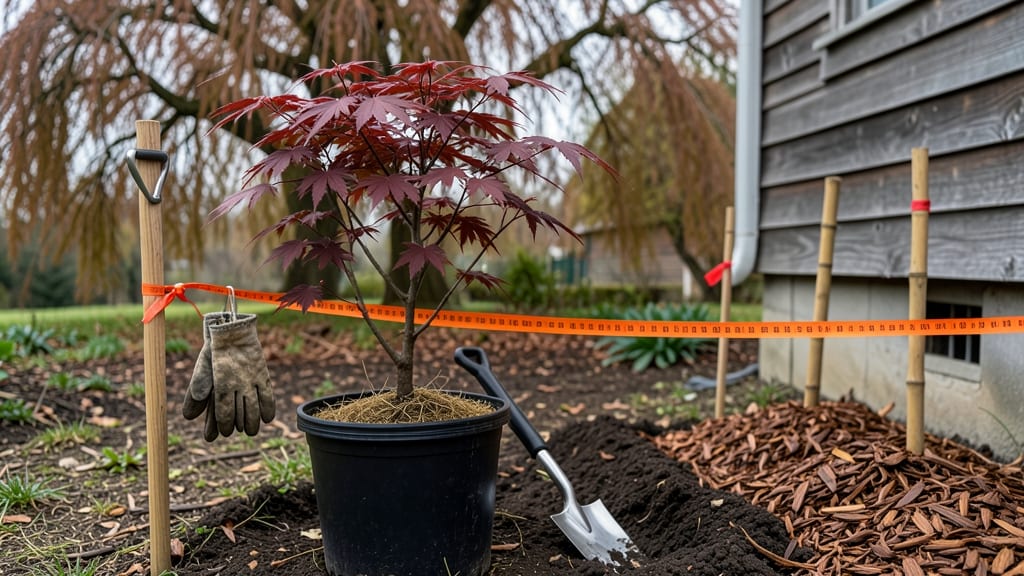
Planting a Japanese Maple 🌳 too close to your house can damage your foundation, block sunlight, or even uproot your favorite shade tree—so getting the spacing right is critical for long-term beauty and structural safety.
You’ve picked the perfect Japanese Maple for your garden, but where exactly should it go? The answer depends on its mature size, root spread, and how much shade you’re willing to trade for curb appeal.
Standard varieties need at least 15–25 feet from your house to avoid root conflicts, while dwarf types can squeeze into tighter spaces—if you’re okay with pruning branches that might brush your roof.
Below, I’ll break down the exact distances by tree size, how to check for foundation risks, and pro tips to keep your Maple thriving without turning your yard into a shadow zone.


Japanese Maple spacing rules: minimum distance from house by tree size & variety
Japanese maples are stunning additions to any landscape, but their placement near your home requires careful planning. The minimum distance depends on the tree variety, mature height, and root spread.
Planting too close can lead to foundation damage, root competition, or even overhanging branches that risk gutters and roofs. Let’s break down the science-backed spacing rules to keep your tree thriving while protecting your home.
Most Japanese maples have shallow root systems that spread widely rather than deeply. This means the canopy width (not just height) determines safe spacing. For example, a standard variety like Acer palmatum 'Bloodgood' can reach 20-30 feet tall with a 15-20 foot spread.
In contrast, dwarf varieties like 'Crimson Queen' stay under 6-12 feet tall with a 4-6 foot spread. These differences directly impact how far you should plant from your house.
Here’s the golden rule: Plant your Japanese maple at least 1.5 times its mature width from your house. This ensures proper airflow, reduces moisture buildup against the foundation, and prevents root intrusion into plumbing or septic systems.
For instance, a 10-foot-wide tree should be planted 15 feet from your home’s exterior walls.
Below is a summary table of recommended distances based on tree variety and mature size. Use this as your guide to avoid common mistakes like planting too close to driveways, sidewalks, or utility lines.
When measuring distance, focus on the tree’s dripline (the outermost edge of the canopy) at maturity. This is where 80% of roots will spread horizontally. For example, if your standard Japanese maple has a 20-foot spread, plant it 30 feet from your house to account for future growth.
This extra space prevents root-bound stress and ensures the tree’s health.
Another critical factor is soil type. Japanese maples prefer well-draining, acidic soil (pH 5.0-6.0). If your yard has clay soil or compacted ground, roots may spread even wider to find nutrients.
In these cases, increase the distance by 20-30% to avoid root competition with your foundation. Always test your soil before planting!
For urban gardens with limited space, consider container planting. Dwarf varieties thrive in large pots (15-20 gallons) and can be placed 5-10 feet from your house. Just ensure the container has drainage holes and use a lightweight potting mix to prevent root rot.
This method also makes it easier to control root spread and move the tree if needed.
Pro tip: Use landscape fabric or a root barrier if planting near driveways or sidewalks. These barriers guide roots downward and away from concrete structures. Install them 12-18 inches deep and 2-3 feet wide, buried vertically around the tree’s planting hole.
This won’t stop root growth entirely but will minimize foundation risks.
Finally, think about seasonal
Foundation safety checklist: how Japanese Maple roots affect concrete, pipes & driveways
Japanese maple roots may look delicate, but they can wreak havoc on your foundation, driveways, and even underground pipes if planted too close. Unlike aggressive species like willows, their roots spread horizontally but can still lift concrete or crack sidewalks over time.
The key is understanding their growth patterns and soil interactions before digging.
Most Japanese maples develop a root system that extends 2-3 times wider than their mature canopy. A 20-foot tree could have roots spreading 40-60 feet, though dwarf varieties stay more contained.
The real risk comes from shallow lateral roots—these are the first to encounter and damage concrete structures.
⚠️ WARNING: Japanese Maple Root Risks ⚠️
Concrete damage: Shallow roots can lift patios or crack driveways within 3-5 years if planted closer than 15 feet from structures.
Pipe risks: Roots may invade sewer lines or irrigation pipes if soil is compacted or poorly drained.
Soil type matters: Clay soils increase root pressure against foundations, while sandy soils reduce risks but may dry out roots faster.
Action step: Test soil 3 feet deep near planting site—amend with compost if compacted.
Start by measuring your house foundation and marking a minimum safe distance of 15-20 feet for standard varieties. For dwarf Japanese maples (6-12 feet tall), reduce this to 8-12 feet. Use a measuring tape to map out the root zone—this is where 90% of lateral roots will develop.
Watch for warning signs like cracked pavement, uneven sidewalks, or water pooling near the tree base. These indicate root pressure or soil displacement.
If you spot these, prune surface roots (but never remove more than 25% of the root ball) and install root barriers made of hard plastic or metal buried 2 feet deep.
For existing trees near structures, create a 3-foot-wide root zone free of compacted soil or heavy mulch. Instead, use organic mulch (like wood chips) to encourage deeper root growth. Avoid installing driveways or patios within the projected canopy—this is where roots will spread most aggressively.
If your property has underground utilities, call 811 before planting to mark pipes and cables. Japanese maples have fine, fibrous roots that can infiltrate small cracks in concrete or plastic pipes. Planting 10+ feet away from utility lines reduces this risk by 70%.