
Pruning
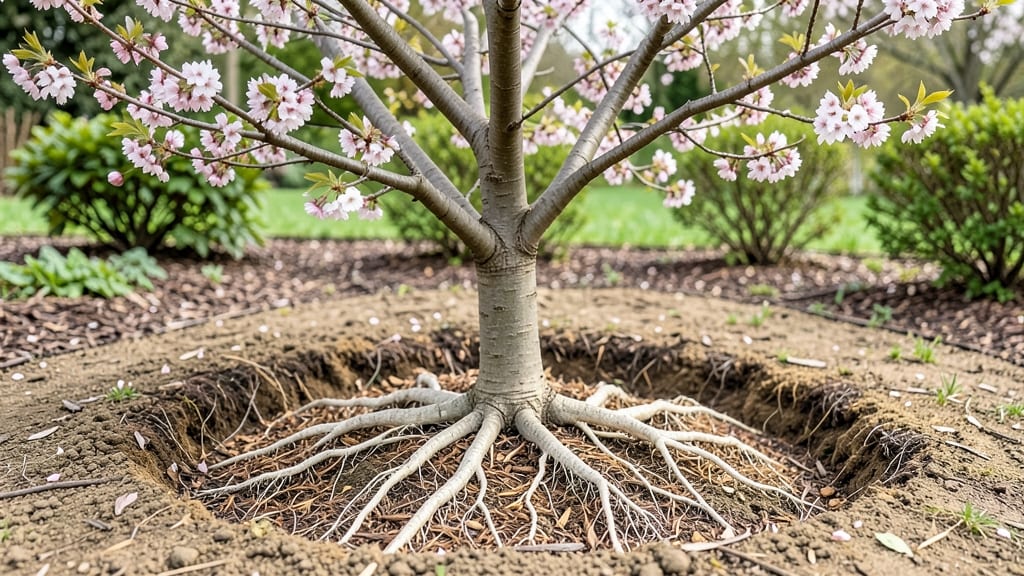
Flowering cherry tree roots spread moderately wide but shallowly, reaching about 3–5 feet deep while extending 2–3 times the canopy width horizontally. Their aggressive lateral growth demands careful spacing and soil prep to avoid crowding nearby plants or structures.
Understanding flowering cherry tree roots is key to their long-term health. 🌳 These trees develop a shallow but expansive root system that prioritizes spreading horizontally over depth, which is why they need well-draining soil to prevent waterlogging.
The lateral roots can extend up to 20–30 feet from the trunk, making proper spacing essential—especially in urban or small yards where competition with sidewalks or other plants is a risk.
What sets these roots apart is their seasonal growth pattern. In their first few years, they focus on establishing lateral roots, which means planting too close to structures or other trees can lead to root damage during pruning or construction.
I always recommend testing soil pH (ideally between 6.0–7.0) and amending with organic matter to support their aggressive but shallow growth habits.
💡 In This Article
- How Flowering Cherry Tree Root Systems Develop Over Time
- Optimal Planting Spaces and Soil Prep for Flowering Cherry Trees
How flowering cherry tree root systems develop over time
Flowering cherry trees develop a distinctive root structure where the primary taproot—though present—rarely dominates. Instead, they rely heavily on fibrous lateral roots that spread aggressively outward within the top 12–18 inches of soil.
This shallow system is an evolutionary adaptation to maximize water and nutrient absorption from surface layers, especially in their native environments where soil is often rocky or compacted. 🌱 The lateral roots can grow up to 20–30 feet horizontally within the first decade, creating a wide but shallow "root mat" that explains why these trees often struggle in heavy clay or waterlogged conditions.
The root development follows a predictable pattern: in the first 3–5 years, the tree focuses on lateral expansion, while deeper roots only penetrate 1–2 feet. After 10 years, the root system may reach 3–5 feet depth, but the majority remains within the top foot.
This shallow habit is why flowering cherries are particularly vulnerable to drought stress—their roots can't access deeper moisture reserves. Seasonally, root growth peaks in early spring when soil temperatures rise above 50°F, aligning with new shoot development above ground.
What most gardeners overlook is how this root system interacts with the tree's canopy. The lateral roots often mirror the tree's branch spread, creating a one-to-one ratio between above-ground and below-ground expansion.
This means a mature flowering cherry with a 20-foot canopy could have roots extending 40 feet in all directions—making proximity to sidewalks, driveways, or neighboring plants a critical consideration.
The roots' sensitivity to soil compaction also explains why these trees often decline in urban settings where heavy foot traffic or construction equipment damages their shallow network. 🚧
Soil conditions play a crucial role in root health. Flowering cherries thrive in well-draining, slightly acidic to neutral soil (pH 6.0–7.0). In alkaline soils (above 7.5), root growth slows due to reduced nutrient availability, particularly iron and phosphorus.
The fibrous roots also release beneficial mycorrhizal fungi that help break down organic matter, but this symbiotic relationship requires loose, aerated soil. Compacted or waterlogged conditions can suffocate these roots, leading to yellowing leaves and reduced flowering—common signs of root stress that many attribute to disease rather than soil issues.
Here's what you need to know about root development stages:
- Years 0–3: Rapid lateral expansion (10–15 feet spread) with minimal depth (6–12 inches)
- Years 4–10: Root system stabilizes horizontally while gradually deepening to 2–3 feet
- Years 10+: Maximum spread (20–30 feet) with depth reaching 3–5 feet in ideal conditions
The shallow nature of these roots also explains why flowering cherries often perform poorly in lawns with dense turfgrass. Grass roots compete for the same shallow soil space, while mowing and foot traffic compact the soil, restricting oxygen flow to the cherry's root zone.
This competition can reduce flowering by up to 40% in the first decade of growth. 🌿